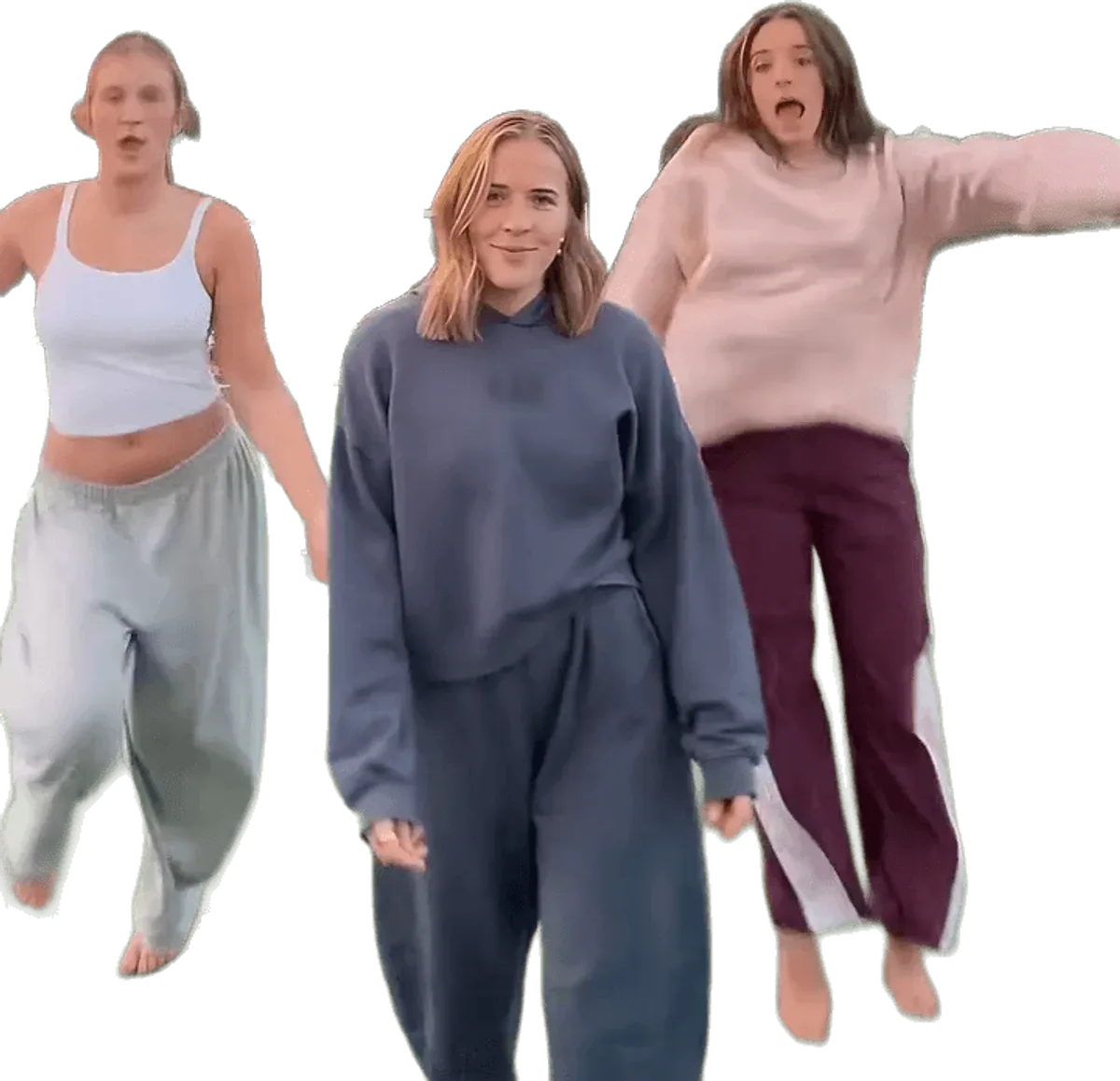
A pasted prompt fails on the Chipmunks dance because the dance is not one person doing one move: it is three people in a fixed row who spin, trade places and run at the camera, and a block of text cannot pin down who is who through any of that. Chipmunks Dance Trend replaces the text box with your photos and a real viral clip that the AI follows, so the people change while the place, the camera and the timing stay put.
Key takeaways
- The trend is a three-person routine to a sped-up edit of You Spin Me Round. It breaks into five beats, and the hardest ones for AI are the spin, the swap and the final run at the lens.
- Text describes what a dance looks like. It cannot tell a model which of three faces is on the left at second eight.
- Faces are most at risk when someone turns their back or spins, which happens in the middle of every version of the clip.
- Chipmunks Dance Trend works from 1 to 3 photos and a real clip of the trend, and fills any empty spot with an AI-made ordinary person who looks like nobody you know.
- The site is independent and unofficial. It does not make cartoon chipmunks or costumes, and it does not promise a perfect likeness.
If you would rather skip the theory, open the generator and try it.
What is the Chipmunks dance trio, and why is it hard for AI?
The Chipmunks dance is a three-person TikTok dance, also called the 3 person dance or the spin me right round dance. It is set to a sped-up, high-pitched edit of You Spin Me Round (Like a Record), the 1984 Dead or Alive single, which sounds like the cartoon chipmunks singing. That is where the name comes from. The most played original, from @bopieandjo, had about 10.9 million plays when it was read on 2026-11-07, and interest in the trend in search began climbing from 2026-10-24.
The routine is short, and every part of it is a trap for a video model. Reading the original clip second by second gives five beats: three dancers stand in a row, with the middle one a step forward, and sway together; they throw their arms up and snap side to side; they turn their backs, spin and drop into a wide bounce with a hair flip; they trade places so each takes a turn at the front; and the middle dancer runs up to the camera laughing to finish.
A solo clip asks a model to keep one face and one body consistent. This one asks for three in the same frame, with overlapping bodies and a constant change of who stands where. Whether the person on the left is still the person on the left after the swap is exactly what a model loses.
What this section proved: the trend is a group routine with at least four moments that stress identity. What it left open: why typing a longer description does not solve it.
Why does a pasted prompt fail on three dancers?
A pasted prompt fails because language is a poor tool for tracking three specific people over time. A sentence can say "three friends dance in a row", but it cannot say which three, and it has no way to say that the person on the left in the first second is the same person who ends in the middle in the ninth.
There are three separate gaps. The first is identity. A prompt describes a type of person, and a model fills the description with an average face. Ask for three friends and you tend to get three similar, generic faces. A photo carries the actual face; a sentence carries an adjective.
The second is order. The routine depends on position: left, middle, right, then a rotation. Text can state an order once, but after the first spin the model may keep the clothes and lose the face, or the other way round.
The third is timing. The dance is cut to a fast, sped-up track, and the beats land on the arm snaps and the drop. Describing "on the beat" in words does not make the moves line up. A model animates a plausible dance, not the particular one in the clip everyone is copying.
More words move the problem around; they do not remove it. The prompt page gives the short version of why this site has no prompt box.
What this section proved: identity, order and timing are three different failures that text cannot close. What it left open: how the swap itself is handled.
How does the swap work when the dancers trade places?
The swap is the moment a prompt-only video most often falls apart. Around the middle of the clip the three dancers move past one another, each taking a turn at the front, and for a second or two their bodies overlap in the frame. A model that tracks faces loosely will blend two of them or hand one person's face to another body.
The reliable way through the swap is to treat each dancer as a slot with its own identity and take the movement from a real clip. Chipmunks Dance Trend starts from a genuine viral version of the dance. The crossing of three bodies, the pause at the front and the exact beat of the trade already exist in the reference. The AI's job becomes replacing the people in that footage, not choreographing a swap from nothing.
Position is the key idea. Photo 1 becomes the middle dancer, the person who starts a step forward and runs at the camera at the end. Photo 2 and photo 3 become the left and right dancers. Because the roles are tied to places in the original clip, the swap carries the right face to the right place, in the order the real dancers moved.
Each photo should show one person. A photo with two people asks one image to do the job of two slots.
What this section proved: swapping works when identity is tied to a position in a real clip. What it left open: what happens to a face when its owner turns away.
How do faces survive the spins and back-turned seconds?
Faces are most fragile when they cannot be seen. In the third beat the trio turns to face away from the camera, spins and drops, and for a few seconds the model has only the backs of three heads. When they turn around again, it has to bring the right faces back from memory, in a new pose and sometimes with hair across them after the flip.
Likeness is not guaranteed, and a face can drift for a moment during the spin, then settle again. That is a property of current video models, not something a better sentence would fix. What helps is the input, which is why the site asks for a sharp, front-facing photo, one person per photo.
It also helps to start from a real clip. A reference clip tells the model what the head does during the spin: the angle, the speed, where the hair goes. With that, the model spends its effort keeping your face attached to that motion instead of working out what a spin looks like.
Higher model tiers generally hold a face through fast motion more closely. Chipmunks Dance Trend offers Standard, Fast, Pro and Ultra, built on different Seedance models from ByteDance. A standard 720p video costs 10 credits, and the Single pack is $6.99 for 10 credits. The pricing page lists every tier and resolution.
What this section proved: the back-turned seconds are the real test, and input photos plus a motion reference are the main defences. What it left open: how the place and camera stay put.
Why do the place, the camera and the timing stay put?
In a pasted-prompt video, the setting is whatever the model decides. Ask for a sunset court and you get a court, but not the one in the viral clip, and the camera moves wherever the model likes. The trend works because every copy looks like the original: a still, low camera, a fixed backdrop, a fast beat.
On Chipmunks Dance Trend each of the six dances is a real viral version of the trend, and the model swaps the people inside that footage. The place, the lighting, the camera and the movement are kept. The dances are Sunset Court (12 seconds, the original), White Studio (11), Bright Hallway (12), Living Room Glow (14), Night Street (15) and Sunny Park (15). Each follows the length of its own source clip, with 15 seconds as the longest. You can browse all of them on the dances page.
Pick Night Street and you get a dark street with lamp light and hoodies, because that is what the source clip is. You choose a place the way you would choose a template, not by describing one.
The timing is kept for the same reason. The track is mixed in after the video is made, since the model renders silently, and the movement follows the original clip's beats. Because the dance and the sound come from the same source rhythm, the arm snaps and the drop line up with the music.
What this section proved: a fixed reference clip keeps place, camera and timing consistent. What it left open: what happens when you have fewer than three people.
What fills the empty spots when you upload one photo?
A trio needs three dancers, but you do not need three photos. Chipmunks Dance Trend accepts 1, 2 or 3 photos at the same price. With one photo, you take the middle spot. The two side spots are danced by AI stand-ins: ordinary adults generated for the video who look like nobody in particular. With two photos, one side is a friend and one is a stand-in; with three, everyone is real.
Two limits: you cannot choose the stand-ins' faces, and one photo always means two AI stand-ins, so a friend in the clip needs their own photo and their agreement. Photos must show adults only, aged 18 or over, who are you or who have agreed. No celebrities.
Uploaded photos are kept for at most 24 hours and are not used to train models.
What this section proved: empty spots are filled by design, not by guesswork. What it left open: why a reference clip beats any description of motion.
Why does a motion reference matter more than words?
A motion reference is the difference between asking a model to invent a dance and asking it to re-cast one. Words describe a dance in vague terms: sway, spin, jump. The reference holds the speed of each sway, how far the arms swing, where the camera sits and how long the swap takes.
There is a second benefit. Because the motion comes from people who actually danced it, the weight shift on the drop, the hair flip and the laugh on the final run at the lens look natural instead of smoothed into a generic wiggle.
There is no official TikTok filter for the Chipmunks dance, and the filter page explains the options. Photo-animation templates move a still image; they do not rebuild a three-person group routine.
What this section proved: the reference carries the movement, the photos carry the people. What it left open: what you should expect from a finished video.
What does this mean for the video you get?
The result is a short MP4 in 9:16, 1:1 or 16:9, with no watermark and the trend sound mixed in, downloadable for 24 hours. A standard video is 10 credits at 720p, and there is no free tier. Credits do not expire, a failed render returns its credits automatically, and completed packs are not refundable, so it makes sense to pick a clear photo and a dance you like before you start.
Expect a likeness that is often close and never guaranteed. If a face drifts on the spin, the fixes are changes in the input: another photo, one person per photo, another dance, a higher tier, or a retry. The fails and fixes post walks through each. When the clip is ready, how to post it covers formats, labels and the sound.
For the route from photo to video, read how to make the Chipmunks dance video, or the overview of the trend.
Chipmunks Dance Trend is an independent tool. It is not affiliated with TikTok, Dead or Alive, Alvin and the Chipmunks or ByteDance, and it does not make cartoon chipmunks or costumes.
Ready to try? Go to the generator.
What this section proved: the output is built from inputs you control. What it left open: nothing here; the questions below cover the rest.
Frequently asked questions
Can I just paste a prompt into an AI video tool to get the Chipmunks dance?
You can try, but it rarely works well. A prompt cannot say which of three faces is on the left, keep them straight through the spin and swap, or copy the place, camera and timing of the viral clip. Chipmunks Dance Trend uses your photos and a real trend clip instead of a text box.
Why do the dancers sometimes look alike in AI trio videos?
Models given only text tend to fill every person with an average face, so three dancers drift toward the same look. Chipmunks Dance Trend uses a separate photo for each real dancer, which gives every slot its own identity. One person per photo works best, and a sharp, front-facing photo helps most.
What happens to the empty spots if I upload one photo?
Two AI stand-ins dance the side spots. They are ordinary generated adults who look like nobody you know. Chipmunks Dance Trend puts your photo in the middle, and adding a second or third photo replaces a stand-in with a friend, at the same price. Friends need to be adults who have agreed.
Why does a motion reference matter?
It carries the real movement, camera and timing, which words cannot. Chipmunks Dance Trend builds each video on a viral version of the dance and swaps the people, so the place, lighting, swap and final run at the lens match the original. Text can only describe a dance in broad terms.